Train Your Decision Stamina: Why Daily Practice Tests Are Workouts for Your Brain
An exam isn't one big test of what you know — it's a few hundred small decisions made back to back. Reading a chapter asks nothing of that. A short daily practice test asks everything of it.
An exam isn't really one big test of what you know. It's a few hundred small decisions made back to back: read the question, weigh the options, commit, move on. Then do it again, and again, for three hours.
And that's the thing almost nobody trains for. We read, we highlight, we re-watch lectures — all low-decision activities — and then we're surprised when the real thing wipes us out. Reading a chapter asks almost nothing of your decision-making. A practice test asks everything of it.
Nobody shows up to race day having never run
The training analogy is worth taking seriously, because the mismatch is the same one you'd spot instantly in a gym.
If you wanted to run a half marathon, you'd run. You wouldn't watch running videos for six weeks and then turn up at the start line. But that is more or less what studying looks like for most people: weeks of input, followed by one high-output day, with almost no rehearsal of the actual thing being asked of you.
The actual thing being asked of you is deciding, repeatedly, without your accuracy sagging. It's why so many people start a test strong and then watch the last third fall apart — and why the fix isn't more content review. You already knew the material at question 40. What ran out was something else.
A caveat, because we'd rather be honest
The pop-science name for that "something else" is decision fatigue, from a broader idea called ego depletion — the theory that self-control draws on a limited pool that drains as you use it. It's a satisfying story and it has had a rough decade in the lab: several of the headline findings have been hard to reproduce, and the size of the effect is genuinely contested.
So we won't tell you it's settled science, because it isn't. What we'll say is narrower and safer: you get better at things you rehearse, and most people never rehearse the deciding part. That doesn't need a mechanism to be worth acting on.
What does hold up: practice testing
Here's the part that isn't contested. When five researchers reviewed ten popular study techniques for a landmark report, most of what students actually do — highlighting, rereading, summarising — came out rated low utility. Only two earned the top rating: practice testing and distributed practice, which is just spacing your work out over days instead of stacking it (Dunlosky et al., Psychological Science in the Public Interest, 2013; readable summary).
Read that pair again, because it's the whole argument for a daily rep rather than a weekly one. The two best-evidenced study habits are test yourself and spread it out. A short practice test every day is both of them at once. A four-hour session on Sunday is neither.
Consistency beats intensity, and it isn't close
Ten focused minutes of test-style questions every day beats a four-hour cram once a week — the same way daily runs beat one monthly attempt at a marathon. Not because the total hours are bigger; they usually aren't. Because you get:
- More separate retrievals. Six sessions of ten minutes means six times you pulled the material out of nothing, on six different days. One long session is one.
- The spacing for free. Daily reps automatically put a gap between the times you meet a fact, which is the second of the two top-rated techniques, and you didn't have to plan it.
- A rep you'll actually do. Ten minutes survives a bad day. Four hours needs a clear evening and a good mood, and it's the first thing cut when the week goes sideways.
The unglamorous version of that last point: the best study plan is the one that still happens in week six. Every plan looks the same in week one.
What a daily rep looks like here
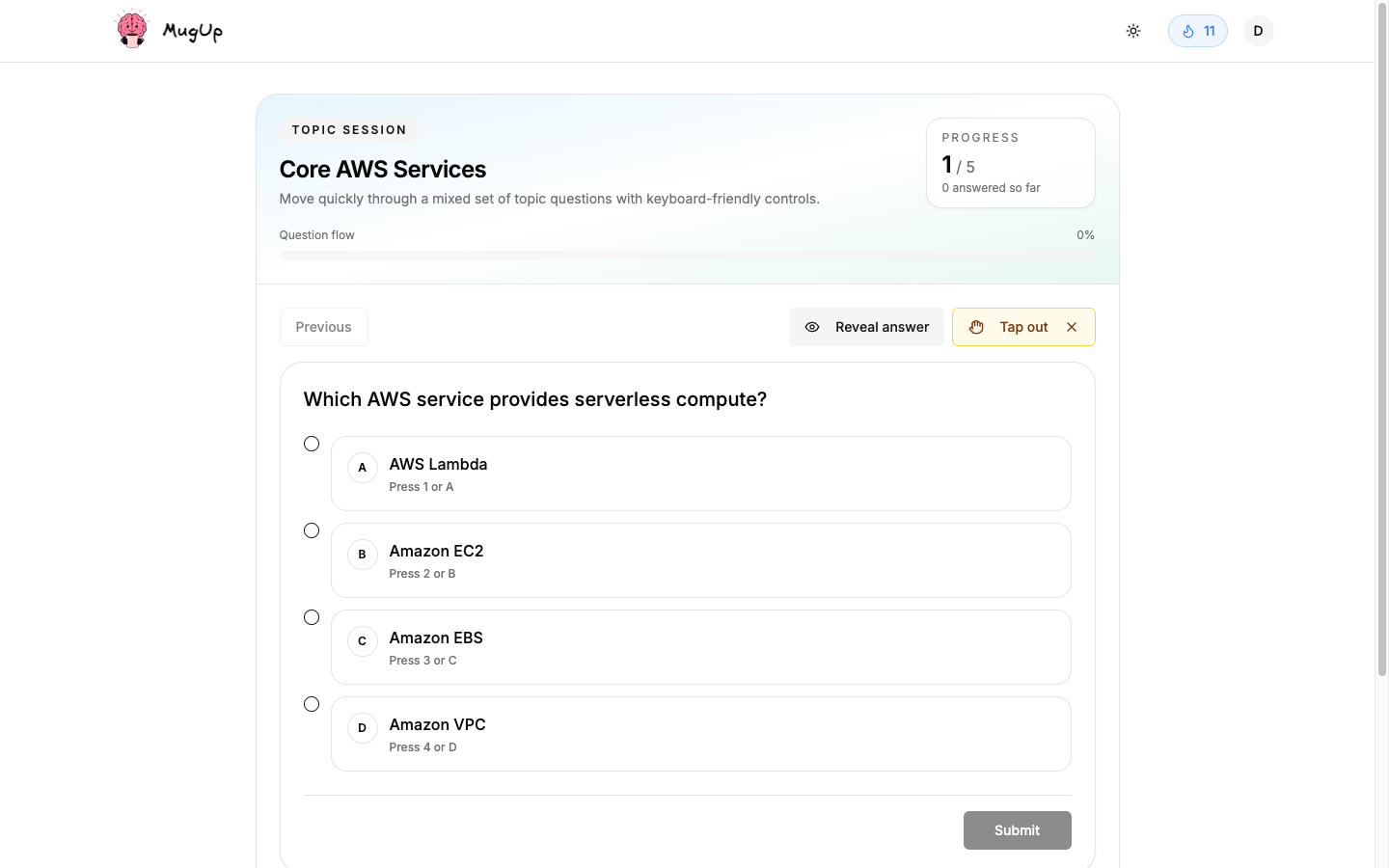
This is a big part of why MugUp is built around producing answers rather than reviewing them. Every session is a run of real decisions — recall it, choose it, type it, match it — not a scroll through notes.
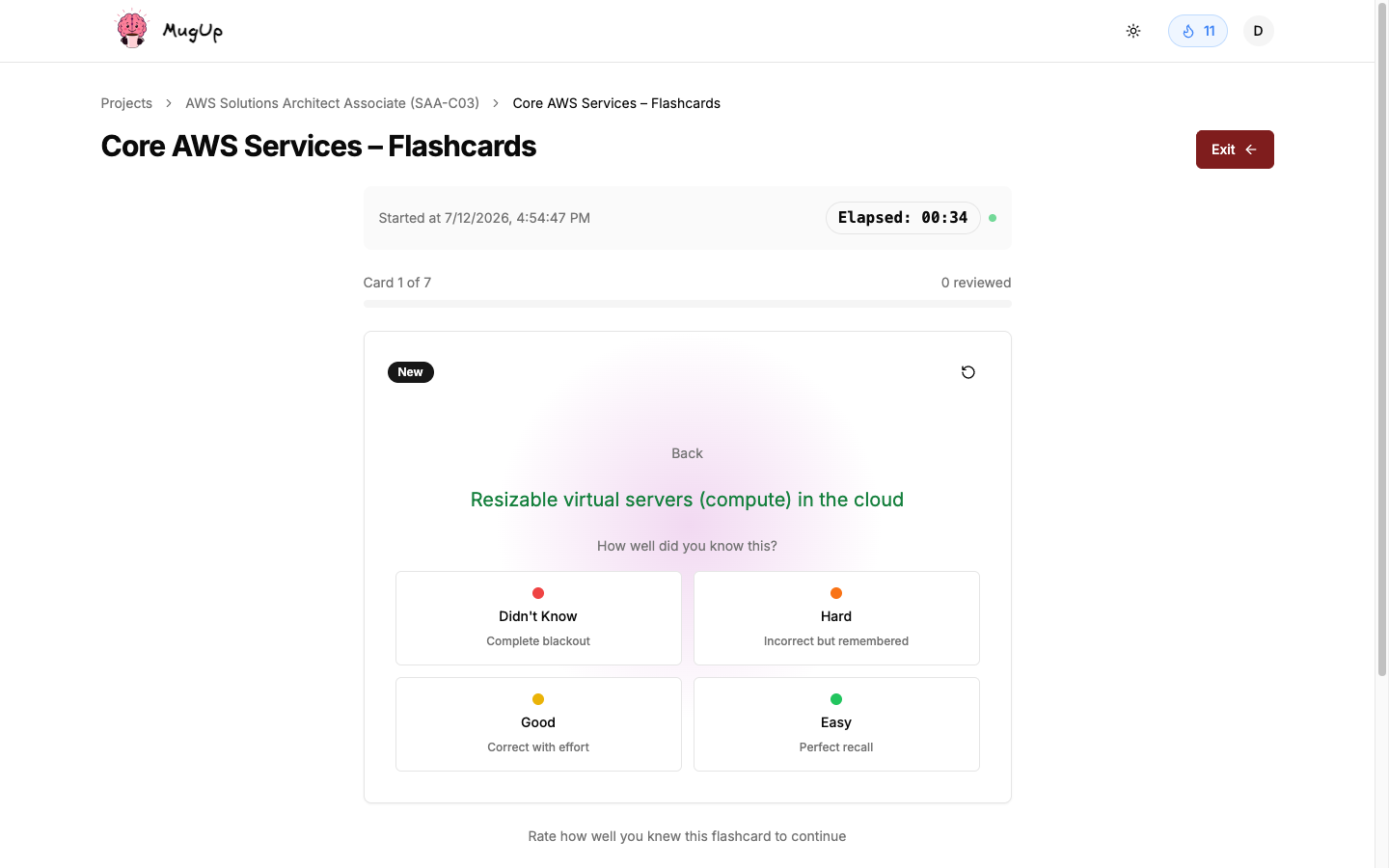
- Four kinds of question, mixed. Multiple choice, fill in the blanks, flashcards, pair match. One session pools them, so you're switching modes instead of settling into one groove.
- The clock runs, but it doesn't chase you. Sessions are timed in the sense that your elapsed time is recorded and shown at the end — there's no countdown ticking down beside a question. The point is a time you can compare to last week's, not extra pressure on top of the exam's.
- What you missed leads the next one. Questions you got wrong or skipped come back at the front of the queue, and the rest come back spaced out.
- Playing isn't rationed. The free-tier limits are on generating new material, not on doing reps with what you've already built. Pro adds the daily Review workout, which pulls everything due across your whole library into one session — see pricing for what's in each tier.
There's also a quieter benefit that shows up on exam day: if you've already answered questions in this format two hundred times, the real paper is one more rep in a familiar shape. Familiarity is doing a lot of the work that people credit to nerve.
It doesn't stay in the exam hall
Ordinary life is one long stream of small decisions too — what to do first, what to skip, when to say no. The same sag that ruins the last section of a test is the reason so many evenings end in careless, snappy versions of ourselves.
We're not going to claim a study habit fixes that. But there's something to be said for spending fifteen minutes a day deciding carefully under mild pressure, on purpose, and then stopping. At minimum it's a rehearsal. At best it makes the high-stakes version feel like a Tuesday.
That's also why the streak here counts any activity that day rather than a full clean sweep of the row — the habit that survives is the one with a low floor.
Start smaller than you think
One short, test-like session a day. Not a plan, not a schedule with colour-coded blocks — one rep, treated like a daily workout, because that's what it is.
Take a topic you're actually studying and turn it into a set of questions, or clone a ready-made deck and do ten minutes on it tonight. Then do ten minutes tomorrow. The compounding is boring to describe and hard to argue with.
The takeaway
Exams don't test knowledge in a vacuum; they test whether you can keep deciding well for three hours. Reading doesn't rehearse that and cramming doesn't either. A short daily practice test rehearses it, gets you the two best-evidenced study habits in one move, and — unlike the four-hour Sunday session — still happens in week six.
More on the habit side: why quizzing yourself is the best way to study and stop re-reading, start generating.
Sources
- Dunlosky, J., et al. (2013). Improving Students' Learning With Effective Learning Techniques. Psychological Science in the Public Interest · summary.
Turn this into a game
Type a topic and MugUp's AI builds quizzes, flashcards, and matching games in seconds. Free to start.