
Habit Stacking, Small Wins, and Building an Environment That Works With You, Not Against You
Consistency is rarely a knowledge problem — it's a systems problem. Habit stacking, momentum from small wins, and an environment that isn't fighting you, plus why we're building MugUp as an ecosystem rather than a study app.
A founder note — MugUp is built and run by a developer who studies with it too.
I've been thinking a lot about why doing the right thing consistently feels so hard. It's rarely a knowledge problem — we all know we should study, review, write, exercise. It's a systems problem. And the two most underrated tools I keep coming back to are habit stacking and momentum.
Habit stacking: let the last thing start the next thing
Habit stacking is simple: attach a new habit to something you already do. After I finish one thing, I start the next — not because I feel motivated, but because the first thing became the trigger for the second. Finish a review session, open the journal. Close the journal, check the todo list. Each completed task is small on its own, but stacked together they carry you through the day without you having to renegotiate with yourself every twenty minutes.
We now ask for that anchor outright. When you commit to reading, writing, or a daily physical or spiritual habit, MugUp asks two things beyond how many minutes: what time you'll do it, and what you'll do it after. The two assemble into a sentence you watch appear as you type — "I'll read at 7:00 AM, after I make my coffee." The anchor is your own words, not a menu of MugUp habits, because the cues that actually work are the kettle boiling or the school run and the app has no idea those exist. And nothing notifies you: writing it down is the entire mechanism, and the habit you named is the reminder.
Momentum: small wins compound, heroics don't
That's the second piece: momentum. Completing a small task makes the next one easier to start. Small, consistent victories stack up in a way one heroic all-nighter never will. Your brain starts to expect the win, and showing up stops feeling like a battle.
Habits leak if your environment fights you
But habits and momentum both leak if your environment fights you. This is honestly why we're repositioning MugUp. It started as a way to make learning and memorizing better with games and spaced repetition. But learning doesn't happen in a vacuum — it happens in the middle of a life full of distractions.
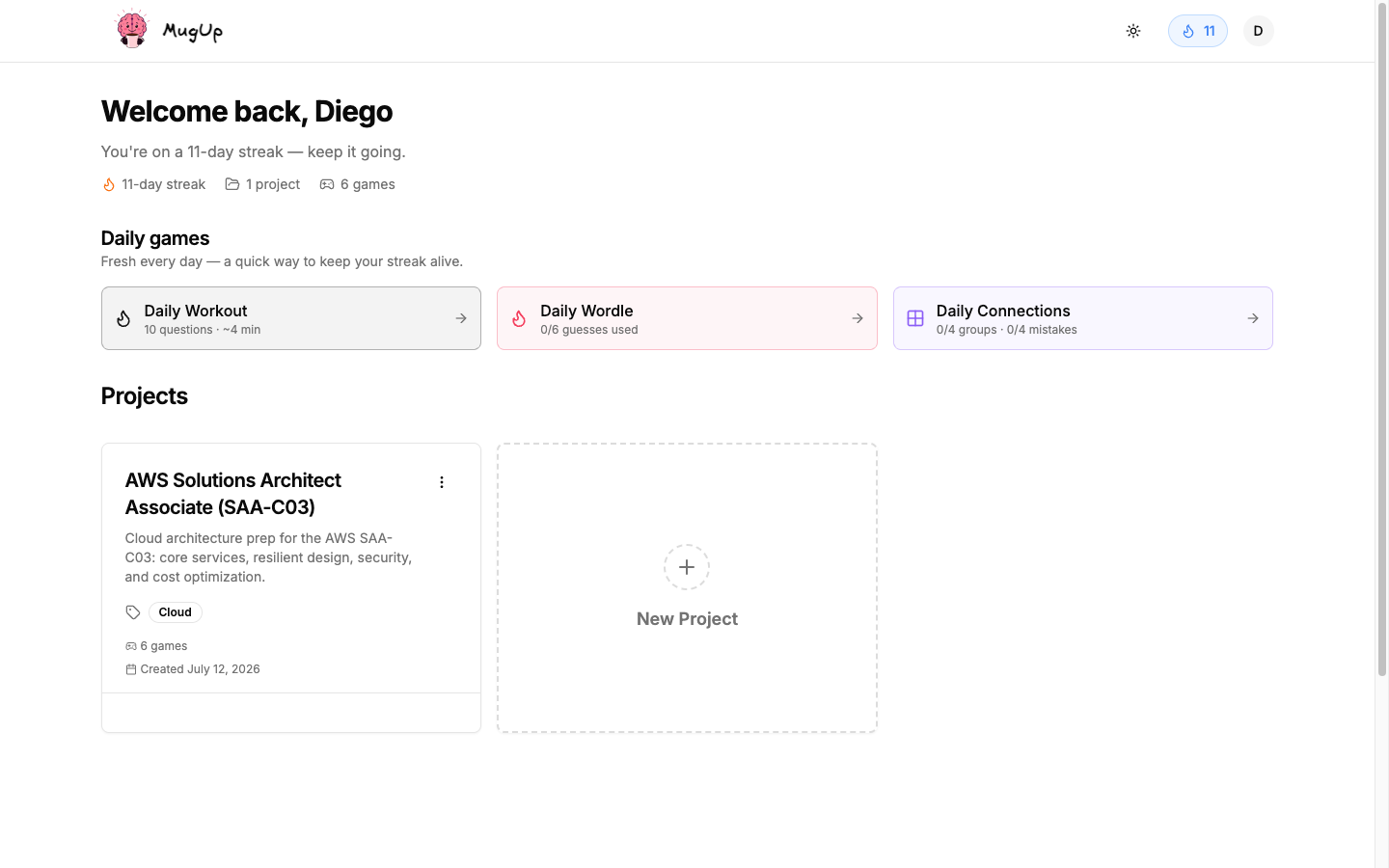
So we've been building an ecosystem around it. Levels, companions, coins and streaks to make learning genuinely fun, plus friends you can follow and a leaderboard where the competition is simply who shows up more. A pomodoro timer with intentional breaks — you name what the break is for before it starts, and if you picked a video, the player closes itself when the break ends, before one video becomes forty. It remembers where you got to, so the next break picks the video up where this one left it. A journal for the writing habit, where the minutes are the goal and the word count is just something you get told afterwards. A plan for the day you write yourself, right under the row of tiles, so the rest of life has somewhere to sit. Even impromptu speaking prompts, to work on the skill school never grades you on.
None of it is a trick. Coins are earned and can never be bought, there's no feed and no ads, and your Life Card rating only weighs the last 28 days — so it goes down when you stop. It's form, not trophies.
An environment that's on your side
The idea is one place where spending your time productively is the default, not the uphill fight. Where your stats grow because you showed up, and showing up got easier because everything around you was designed for it.
If you want to try the stack rather than read about it: start free — no card — and pick one thing to attach to something you already do. Fifteen minutes, one trigger, one small win.
The takeaway
You don't need more willpower. You need a stack of small habits, a bit of momentum, and an environment that's on your side.
More on the mechanics: what Duolingo actually gets right, and why spaced repetition works.
Turn this into a game
Type a topic and MugUp's AI builds quizzes, flashcards, and matching games in seconds. Free to start.