
Anki Is Legacy Software — Studying Deserved an Upgrade
Anki proved the method: active recall, spaced out over time. What it never updated was the experience. Here's the case for keeping the engine and rebuilding everything around it — and where Anki is still the better tool.
Respect first: Anki earned its place. It put spaced repetition in millions of pockets and proved that flashcards, done properly, are one of the most powerful learning tools we have. It's free, it's open source, and it will still be running in twenty years. We're not here to argue with the method. We're here to argue with the experience.
Because opening Anki feels like booting up software from another era. You land in a deck list, you build every card yourself, and if you want to change how reviews behave you go through a settings surface with more knobs than most people will ever touch. It was built for students willing to fight their tools to get results — and plenty still do, and get them. They just shouldn't have to.
The method was never the problem
Producing an answer beats rereading one, and a question that comes back just before you'd have forgotten it sticks better than one you drill five times tonight. That's the engine. It works, and we use exactly the same one.
What stopped evolving is everything wrapped around it. Somewhere along the way we accepted that serious studying has to look boring — grey, solitary, joyless — as if fun and effectiveness were opposites.
They're not. If anything they're allies. You don't need discipline to open an app you actually like opening. You don't need a reminder to come back to something that feels like play. The apps competing for your evening figured this out years ago; study tools are just late.
Legacy doesn't mean bad
Legacy software isn't bad software. It's software that solved yesterday's problem in yesterday's way, and then stopped. Anki answered "how do we make memory scientific?" and answered it well enough that nothing else had to.
The next question is different: how do you make remembering something you want to do on a Tuesday, in week six, when nobody is checking? That question isn't about the algorithm at all. It's about the twenty seconds between picking up your phone and deciding what to open.
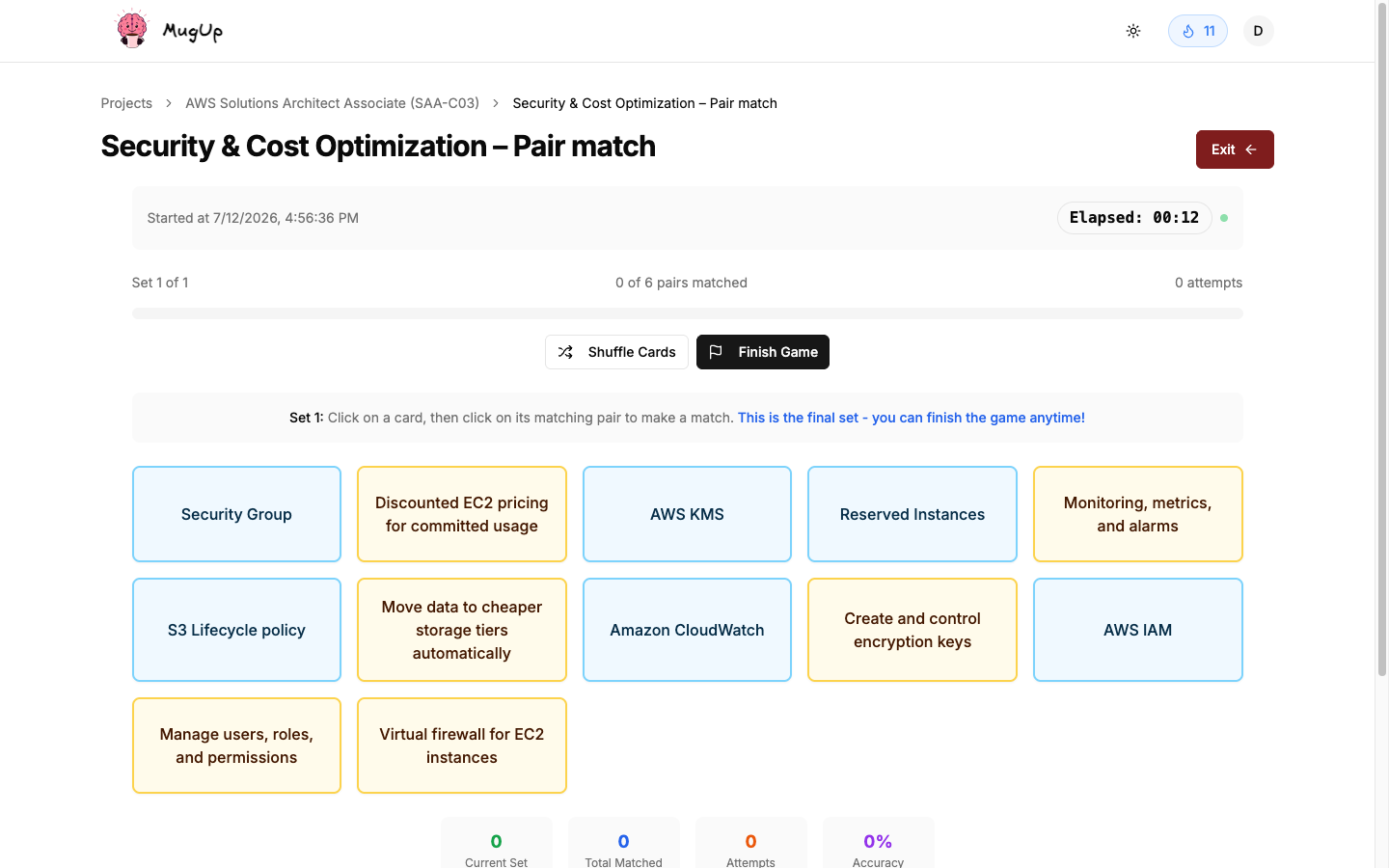
What we changed, and what we kept
Same engine. Different everything else.
- Interactive, not passive. Your material becomes four kinds of drill, not one: multiple choice, fill in the blanks, flashcards, and pair match — a board of terms and meanings you clear under time, which is a dozen acts of recall stacked into one round. A single session mixes them, so you're never doing the same motion forty times.
- Built for you, not by you. The reason most people quit Anki isn't the reviews, it's the deck-building. Paste a topic, upload your notes or a PDF, and the questions come from that material. The scheduling Anki gives you, without the weekend of card authoring.
- Social, not solitary. Follow friends, see their progress, climb an XP leaderboard, publish a deck for anyone to play or clone. There's no live multiplayer here and we're not going to fake one — the competition is who shows up more. Which, as it turns out, is the competition that matters.
- Colour, motion, streaks. Streaks that forgive a missed day, XP and levels, companions you earn. The same mechanics as the apps built to take your evening — minus the feed, minus the ads, with nothing you can buy your way past (coins are earned and can never be bought), and a rating that can go down, because it only weighs the last 28 days.
That last list is the honest version of "gamified." Borrowing the mechanics is only defensible if you also say what you left behind.
Bring your deck across
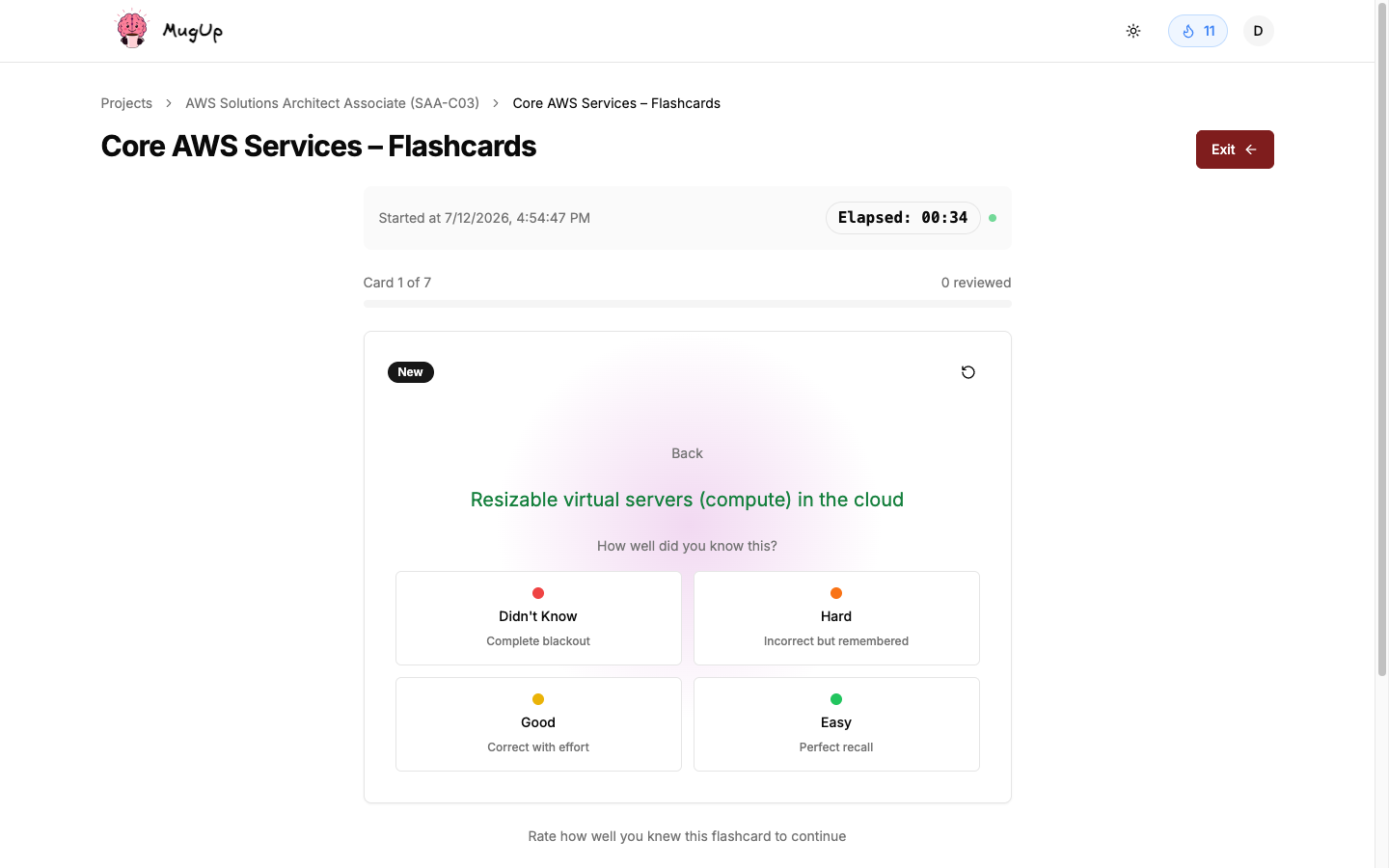
If you've already built something in Anki, you don't have to abandon it. Export an .apkg and import it: subdecks become topics, notes become flashcards, cloze notes become a front and a back. It's parsed in your own browser, and it's on the free tier — up to 200 cards at a time, and you can import again as many times as you like.
Two honest limits. Media doesn't come across — images and audio are stripped, and the preview tells you how many cards had them. And your review history stays in Anki: the cards arrive new, so the scheduling starts fresh. "Pick up exactly where you left off" would be a nice thing to claim and it isn't true.
Once a topic is in, you can generate the other three game types on it — the import only ever brings flashcards.
Where Anki is still the better tool
Under-promising is the brand, so: there are real reasons to stay.
- It's free and offline, forever. No account, no server, no subscription, no company that has to still exist next year. That's a genuine feature and we can't match it.
- Add-ons. Image occlusion, custom schedulers, hundreds of community extensions. MugUp is text only — no image cards, no diagram questions, no occlusion.
- Total control. If you enjoy tuning your own scheduler, Anki hands you the dials. We deliberately don't.
- Your history. Years of review data is worth something, and an import doesn't carry it.
If you've built a system in Anki that you enjoy and open every day, keep it. Genuinely. The tool that gets opened wins, and if that's Anki for you then Anki is the right answer. This post is for the much larger group who tried it, agreed with every word about why it works, and still stopped opening it by week three.
Try it on something you're actually studying
Take one thing you're trying to learn — a chapter, a certification domain, a language unit — and turn it into something you'd play rather than something you'd endure. Then see whether showing up gets easier.
Start free, or browse the deck library and clone one to see the shape of it first. Pro adds the daily Review workout, which pulls everything due across your whole library into one session — details on the pricing page.
The takeaway
The new generation of students isn't lazier or less serious. They just refuse to believe that learning has to be miserable to count, and they're right. Learning started out joyful for every one of us — watch any kid discover something. Anki proved the science; the job now is keeping the science and losing the slog, so that showing up on day 40 doesn't take willpower at all.
More on this: why learning stops being fun when we grow up, and what Duolingo actually gets right.
Turn this into a game
Type a topic and MugUp's AI builds quizzes, flashcards, and matching games in seconds. Free to start.